

Every real estate transaction coordinator saves agents something more valuable than paperwork—they save time, protect profitability, and create room for business growth. Yet many agents continue managing every file themselves because they believe they’re saving money.
The truth? They often aren’t.
Short Answer
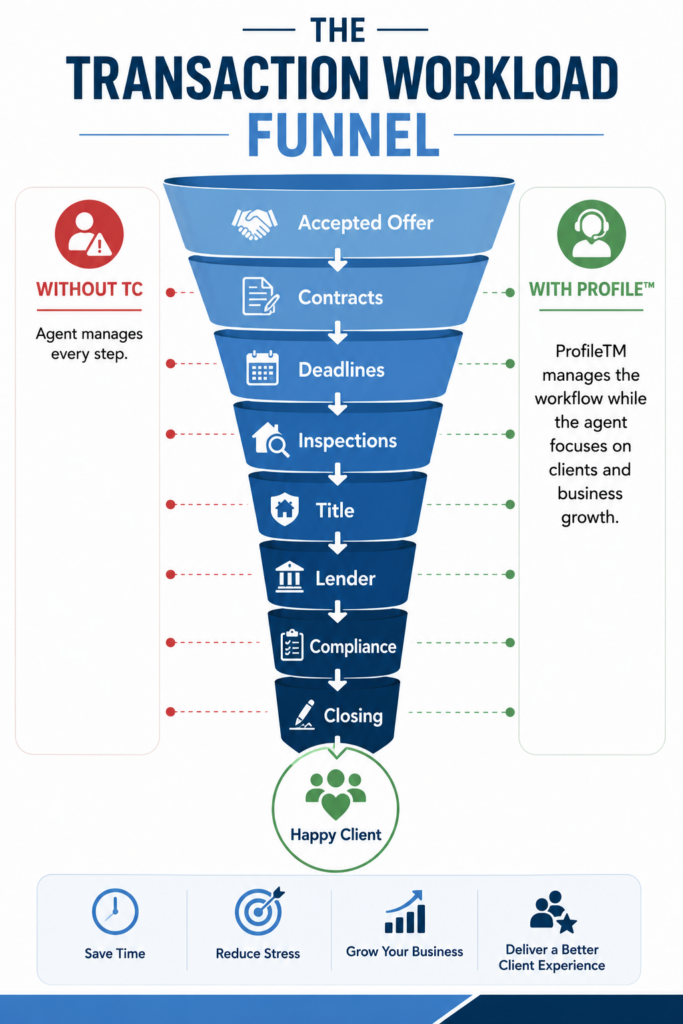
Managing your own transactions may appear free, but every contract, deadline, inspection, lender update, title communication, amendment, and compliance requirement takes valuable time away from income-producing activities. For many agents, the opportunity cost quickly exceeds the cost of hiring a transaction coordinator.
Looking for more transaction coordination resources? Explore our growing library of articles designed to help agents simplify every step of the contract-to-close process.
You’re Not Just Managing Paperwork
When most agents think about transaction coordination, they picture paperwork.
In reality, paperwork is only one small piece of the process.
Every accepted purchase agreement starts a project involving multiple people, dozens of deadlines, and countless moving parts.
A typical residential transaction often includes coordination between:
- Buyers
- Sellers
- Cooperating agents
- Lenders
- Title companies
- Inspectors
- Appraisers
- Homeowners associations
- Insurance providers
- Your brokerage
Every communication matters.
Every deadline matters.
Every document matters.
Missing one item can delay a closing, create unnecessary stress, or damage the client experience.
That’s why many top-producing agents eventually realize that transaction coordination isn’t simply administrative work—it’s risk management.
What Actually Happens During One Transaction?
Many agents underestimate the amount of work happening behind the scenes because much of it happens in small increments throughout the transaction.
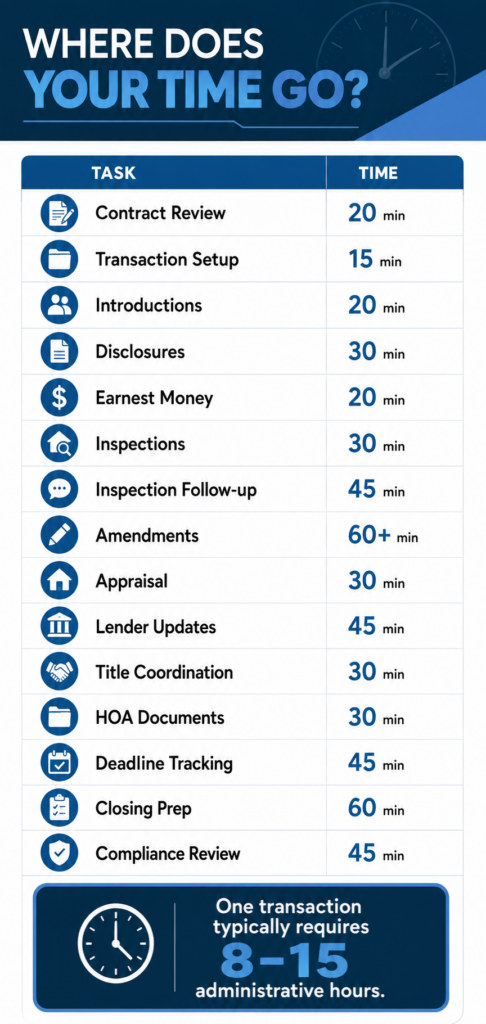
Here is what one typical transaction often requires after an offer is accepted.
| Task | Approximate Time |
|---|---|
| Review contract package | 20 minutes |
| Create transaction file | 15 minutes |
| Send introductions | 20 minutes |
| Verify disclosures | 30 minutes |
| Coordinate earnest money | 20 minutes |
| Schedule inspections | 30 minutes |
| Inspection follow-up | 45 minutes |
| Amendment processing | 60+ minutes |
| Coordinate appraisal | 30 minutes |
| Lender communication | 45 minutes |
| Title communication | 30 minutes |
| HOA document coordination | 30 minutes |
| Monitor contingency deadlines | 45 minutes |
| Closing preparation | 60 minutes |
| Brokerage compliance | 45 minutes |
Most transactions require 8–15 hours of administrative work, while more complex transactions can easily exceed that estimate depending on financing, negotiations, inspection issues, and amendments.
Now multiply that across an entire year.
An agent closing:
- 15 transactions annually may spend 120–225 hours on transaction management.
- 30 transactions could require 240–450 administrative hours.
- 50 transactions may consume well over 500 hours.
That’s time that isn’t being spent meeting clients, generating referrals, showing homes, negotiating offers, or growing your business.
Why a Real Estate Transaction Coordinator Saves More Than Time
Many agents initially hire a real estate transaction coordinator because they feel overwhelmed.
Ironically, time savings often become the smallest benefit.
A professional coordinator also provides consistency.
Instead of remembering every deadline yourself, someone is actively tracking timelines, communicating with vendors, following up on documents, and helping keep every party moving toward closing.
That creates several advantages.
Better Client Experience
Clients notice responsiveness, organized communication, and the small details that contribute to creating a better client experience from contract to closing.
They notice organized communication.
They notice when nothing falls through the cracks.
According to the National Association of REALTORS®, improving the client experience remains one of the primary reasons agents adopt new technology and workflow systems. The same principle applies to outsourcing operational work so agents can focus on serving clients.
National Association of REALTORS® Technology Survey
https://www.nar.realtor/research-and-statistics
Better Compliance
Brokerages continue increasing documentation requirements.
Having another experienced set of eyes reviewing timelines and required documents helps reduce preventable errors while supporting brokerage compliance best practices throughout the transaction.
While no coordinator replaces legal or brokerage oversight, organized transaction management significantly reduces administrative risk.
Better Business Growth
The biggest opportunity cost isn’t paperwork.
It’s everything you could have been doing instead.
If transaction management keeps you from calling past clients, following up with leads, hosting open houses, or attending networking events, those lost opportunities have a real financial impact.
Real Estate Transaction Coordinator vs. Doing It Yourself
Let’s compare the two approaches.
| DIY Transaction Management | Transaction Coordinator |
|---|---|
| Agent tracks every deadline | Deadlines monitored proactively |
| Agent answers every administrative email | Communication support keeps files moving |
| Nights and weekends spent catching up | More personal time |
| Higher chance of overlooked details | Consistent systems and checklists |
| Less time prospecting | More time generating business |
| Business growth limited by available hours | Easier to scale production |
The question isn’t simply whether you can manage every transaction yourself.
Most experienced agents absolutely can.
The better question is:
Should you?
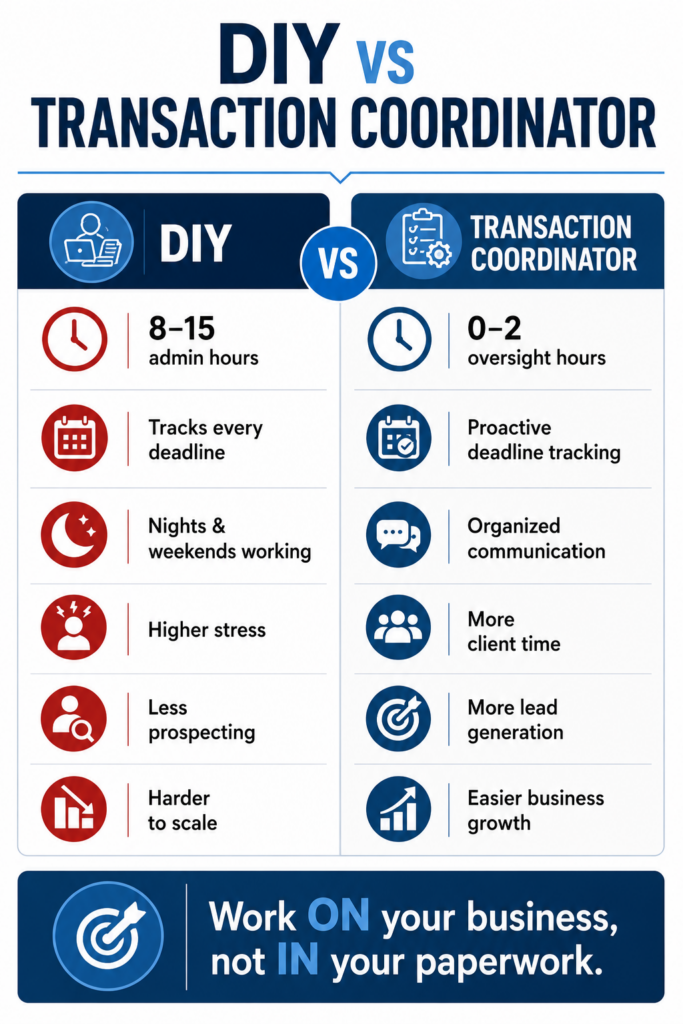
The Cost Comparison: DIY vs. Hiring a Real Estate Transaction Coordinator
| DIY | Transaction Coordinator |
|---|---|
| 8–15 admin hours per transaction | 0–2 oversight hours |
| Higher administrative burden | Streamlined workflow |
| Greater risk of missed deadlines | Proactive deadline management |
| Evenings spent catching up | More personal and family time |
| Less time for lead generation | More time for revenue-producing activities |
| Growth limited by available hours | Easier to scale your business |
If one additional client appointment or one extra closing results from the time you gain, the investment in a transaction coordinator can often pay for itself. The real question isn’t whether you can manage your own transactions—it’s whether your time is best spent doing it.
How Much Is Your Time Actually Worth?
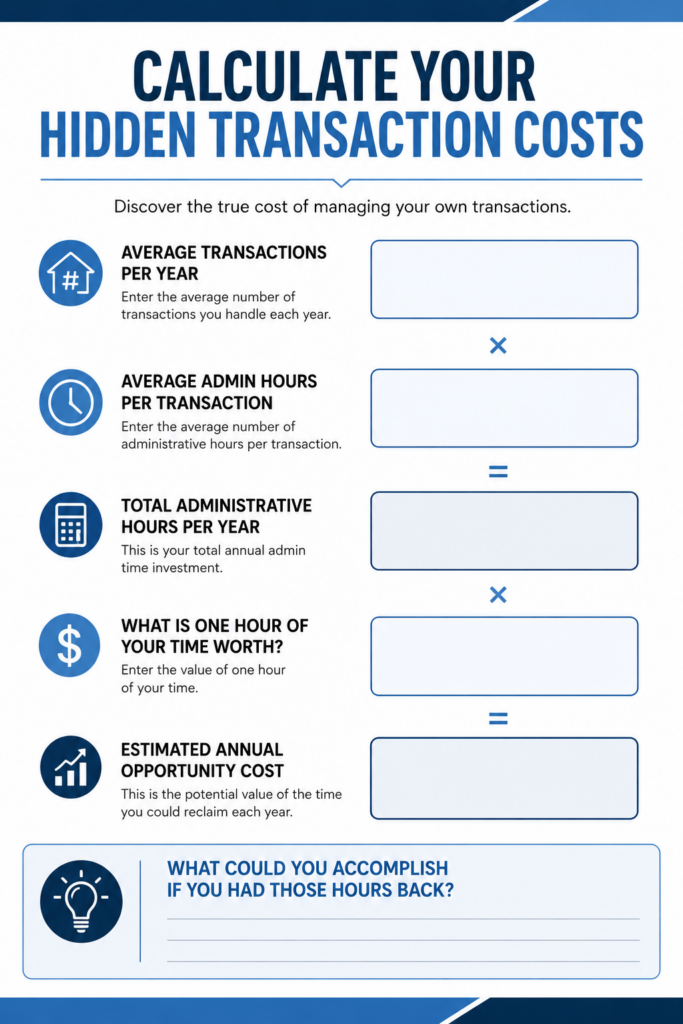
Let’s do a simple exercise.
Imagine your average commission after brokerage splits is $4,000.
Now imagine spending 12 administrative hours managing one transaction.
That’s roughly 12 hours that could have been used to:
- Prospect for future business
- Meet with buyers
- Prepare listing presentations
- Attend networking events
- Follow up with past clients
- Improve your marketing
If those 12 hours eventually help generate one additional closing each year, outsourcing your transaction coordination may have already paid for itself.
In fact, many experienced agents find that the biggest return isn’t reducing stress—it’s creating enough capacity to close additional transactions. Industry analyses have similarly found that the administrative time absorbed by each file can be substantial enough that even one additional closing can offset the cost of transaction coordination for many agents.
Real Estate Transaction Coordinator: When Should You Hire One?
Many agents assume transaction coordinators are only for high-volume teams.
That’s no longer true.
Today’s outsourced coordination models make professional support accessible long before you’re closing 100 transactions each year.
A real estate transaction coordinator often becomes worthwhile when:
- You regularly work evenings just to stay caught up.
- Deadlines feel difficult to manage.
- Administrative work delays lead generation.
- Client communication starts feeling reactive instead of proactive.
- You’re turning away opportunities because you’re already too busy.
The best time to hire help usually isn’t when you’re overwhelmed.
It’s before you reach that point.
Hidden Costs Agents Don’t Think About
The hours spent managing paperwork are only part of the equation. Some of the biggest costs of handling every transaction yourself are the ones that don’t show up on a timesheet.
Missed Business Opportunities

Every hour spent chasing signatures or following up with a lender is an hour you’re not:
- Calling past clients for referrals
- Meeting new buyers and sellers
- Creating marketing content
- Hosting open houses
- Building relationships with your sphere
- Working on your business instead of in it
These activities are what generate future income. Administrative work, while essential, doesn’t directly create new business.
Burnout
Many agents don’t realize how much mental energy transaction management requires until they finally delegate it.
Constantly checking deadlines, responding to emails after hours, and worrying about compliance can lead to decision fatigue and burnout. That often affects productivity, client service, and work-life balance.
Slower Growth
If you’re personally responsible for every administrative task, your business can only grow as fast as your available hours.
Delegating transaction coordination creates capacity. Instead of hitting a ceiling, you can take on more clients with confidence while maintaining a high level of service.
Common Transaction Mistakes That Delay Closings
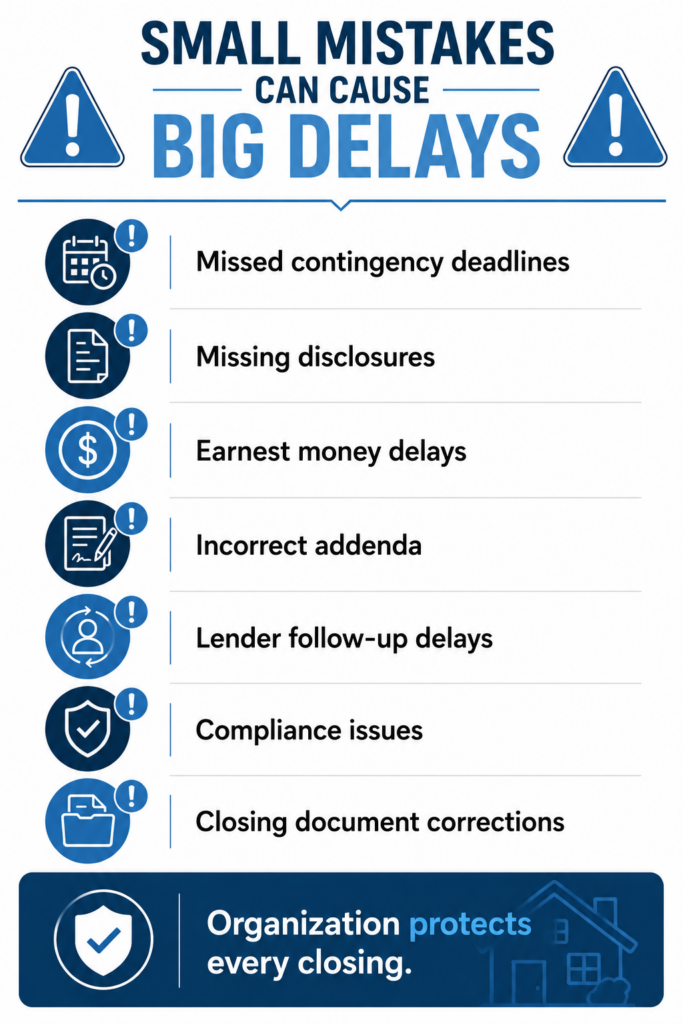
Even experienced agents can overlook small details when they’re juggling multiple transactions.
While every transaction is unique, these are some of the most common issues that can create unnecessary delays:
- Missing contingency deadlines
- Incomplete disclosure packages
- Delayed earnest money verification
- Unsigned or incorrect addenda
- Missed lender or title requests
- Incomplete brokerage compliance files
- Last-minute closing document corrections
None of these mistakes are usually caused by a lack of knowledge. More often, they’re the result of being pulled in too many directions at once.
Having a dedicated process—and someone focused on keeping every file organized—helps reduce these preventable issues.
The Bottom Line
There’s nothing wrong with managing your own transactions—especially when you’re first building your business.
But as your business grows, your role should evolve.
The highest-performing agents spend more time advising clients, negotiating contracts, building relationships, and implementing proven productivity tips for real estate agents that help them scale without adding more hours to the day. They spend less time tracking paperwork and administrative deadlines.
A real estate transaction coordinator doesn’t replace your expertise—they protect it.
Instead of wondering whether you’ve missed a deadline, you gain confidence knowing someone is helping keep every file moving forward.
That’s not just an operational improvement.
It’s a business strategy.
If your goal is to grow your business without sacrificing your client experience, partnering with real estate transaction coordination services can be one of the smartest investments you make.
Frequently Asked Questions
Is hiring a real estate transaction coordinator worth the cost?
For many agents, yes. If transaction management is preventing you from prospecting, serving clients, or growing your business, the value of your time often exceeds the cost of professional transaction coordination.
What does a real estate transaction coordinator actually do?
A transaction coordinator manages the administrative side of a real estate transaction after a contract is accepted. Responsibilities often include document management, deadline tracking, communication with lenders and title companies, coordinating inspections, monitoring compliance requirements, and helping keep the transaction on schedule.
How many hours does a transaction usually require?
While every transaction is different, many residential transactions require approximately 8 to 15 hours of administrative work. More complex transactions involving multiple amendments, inspections, financing issues, or HOA documentation can require significantly more time.
When should an agent hire a transaction coordinator?
Many agents benefit from hiring a transaction coordinator before they feel overwhelmed. If evenings are spent catching up on paperwork, deadlines are becoming difficult to manage, or administrative work is limiting business growth, it’s often the right time to consider outsourcing.
Whether you’re managing five transactions a year or fifty, your time is one of your most valuable business assets.
At ProfileTM, we partner with Minnesota real estate agents and teams to simplify the contract-to-close process with dependable, accurate, and responsive transaction coordination. Our customized systems help you spend less time managing paperwork and more time serving clients, generating referrals, and growing your business.
Ready to see what your business could look like with professional transaction coordination?
Learn more about our Transaction Coordination Services or contact ProfileTM today to discover how we can help your next closing run more smoothly.