

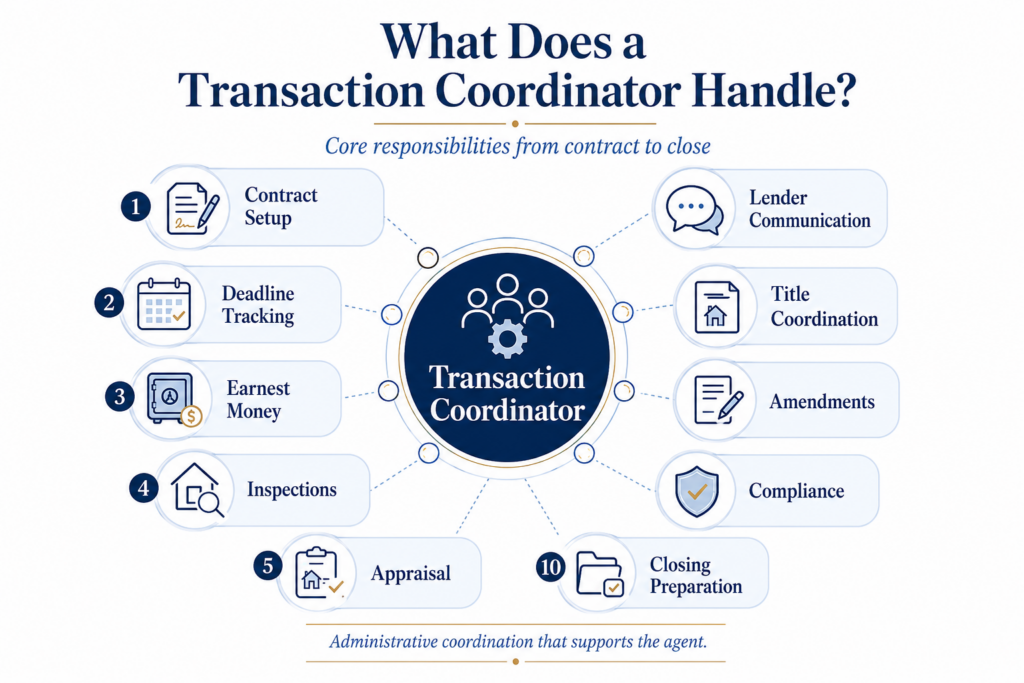
If you have ever wondered what does a transaction coordinator do, the simplest answer is this: a real estate transaction coordinator manages the administrative and operational details that move a signed contract toward closing.
A transaction coordinator, often called a TC, tracks deadlines, organizes documents, coordinates communication, follows up with the people involved in the transaction, helps maintain a complete brokerage file, and keeps the contract-to-close process moving. The agent remains responsible for representation, advice, negotiations, and the client relationship.
For a busy real estate agent, that distinction matters.
A transaction coordinator does not replace the agent. A great TC creates the systems behind the agent so the agent can spend less time managing paperwork and more time serving clients, negotiating, prospecting, and growing the business.
At ProfileTM, our transaction coordinators manage contract-to-close details including deadlines, disclosures, title and lender communication, document management, compliance support, and milestone updates.
What Does a Transaction Coordinator Do? The Short Answer
A real estate transaction coordinator manages the administrative workflow of a transaction, typically from an executed contract through closing.
That work commonly includes:
- Reviewing the transaction file for completeness
- Identifying important dates and obligations
- Building and maintaining the transaction timeline
- Tracking contingencies and deadlines
- Gathering required documents and signatures
- Coordinating with title, lenders, inspectors, appraisers, agents, and other parties
- Providing transaction updates
- Organizing brokerage compliance documentation
- Preparing the file for closing
- Confirming required post-closing documentation is organized
The exact scope varies by state, brokerage, transaction type, and the coordinator’s service agreement.
That last point is important. A transaction coordinator should never be treated as an undefined person who simply “handles everything.”
The strongest TC relationships have clear ownership, clear communication, and clear boundaries.
What Does a Transaction Coordinator Do? The ProfileTM 5C Framework
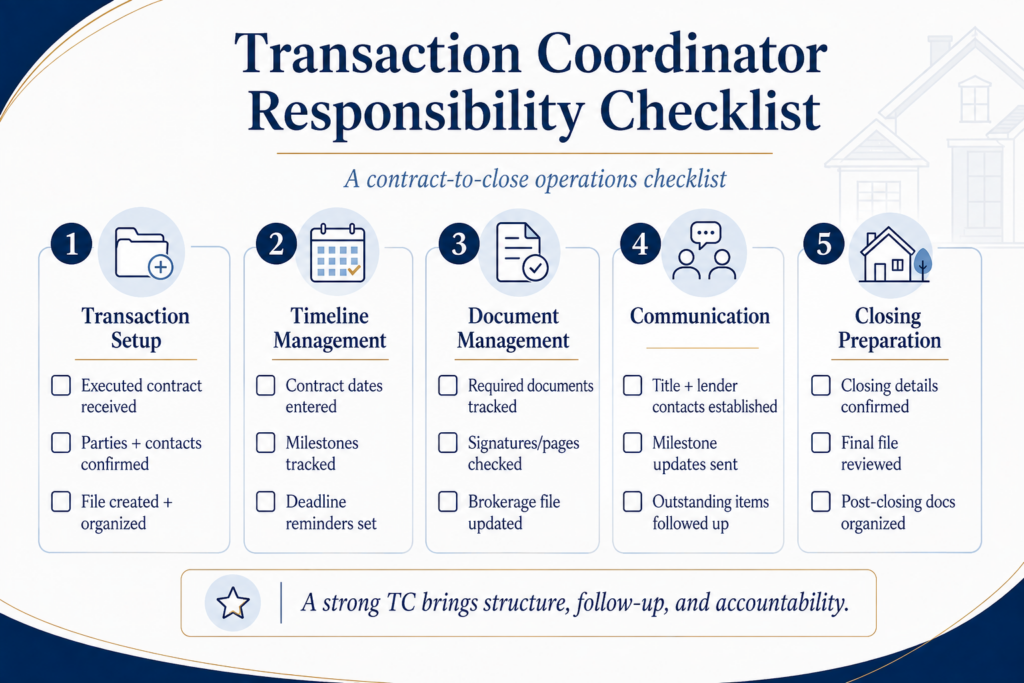
To understand what a transaction coordinator actually does, it helps to organize the role into five functions.
1. Capture
The TC gathers the information needed to establish an accurate transaction file.
2. Calendar
The TC identifies and tracks contractual dates, contingencies, milestones, and follow-up points.
3. Coordinate
The TC keeps the administrative process moving among the agent, client, lender, title company, inspectors, appraisers, cooperating agent, and other parties.
4. Confirm
The TC checks that documents, signatures, updates, and required administrative steps have been completed.
5. Close
The TC helps prepare the administrative side of the transaction for an organized closing and completed brokerage file.
This creates a useful distinction:
The agent leads the relationship and real estate representation. The transaction coordinator manages the operational system supporting the transaction.
That is the real purpose of transaction coordination.
What Does a Transaction Coordinator Do After a Contract Is Signed?
Once an offer becomes an executed contract, the administrative workload increases quickly.
There are documents to organize, deadlines to identify, parties to notify, signatures to collect, inspections to track, lender and title updates to obtain, and brokerage requirements to satisfy.
A professional TC creates structure around all of it.
ProfileTM’s own contract-to-close workflow begins by reviewing the executed contract, confirming the parties, mapping obligations, creating a timeline and compliance plan, coordinating the parties involved, providing milestone updates, and completing final pre-closing verification.
Here is what that looks like in practice.
1. Transaction Intake and File Setup
The first job is turning a newly executed purchase agreement into an organized transaction.
The coordinator may:
- Receive the executed contract and related documents
- Confirm basic property and transaction information
- Identify buyers, sellers, agents, lenders, and title contacts
- Create the transaction in the appropriate management systems
- Organize the file according to brokerage requirements
- Review paperwork for missing signatures, dates, pages, or documents
- Establish the transaction checklist
- Identify the major contractual milestones
This early setup is more important than it appears.
If the file begins disorganized, every later step becomes harder.
If it begins with a documented process, the TC has a reliable roadmap for what needs to happen next.
2. Contract and Document Management
Document management is one of the most visible transaction coordinator responsibilities, but it involves much more than saving PDFs into a folder.
A TC may help monitor whether required transaction documents have been received, signed, stored, and submitted correctly.
At ProfileTM, file-management support can include cross-checking signed disclosures against transaction requirements, locating missing documents in e-signature platforms, checking dates and signatures on addenda, identifying missing pages or inconsistencies, and uploading documentation into brokerage compliance systems.
That creates a second layer of attention on the file.
The agent is still responsible for the transaction and for fulfilling applicable brokerage, contractual, and legal obligations. However, the coordinator provides a repeatable administrative process designed to catch incomplete paperwork before it becomes a last-minute problem.
3. Deadline and Contingency Tracking
Real estate contracts are driven by dates.
Depending on the transaction, there may be deadlines connected to inspections, earnest money, financing, appraisal issues, title, association documents, contingencies, closing, and other contractual obligations.
A transaction coordinator builds those dates into a system and tracks them throughout the transaction.
The TC may:
- Record applicable contract dates
- Add reminders to the transaction calendar
- Monitor upcoming milestones
- Notify the agent about approaching deadlines
- Follow up when administrative items remain outstanding
- Update the timeline when properly executed changes affect the transaction
The coordinator does not make contractual decisions for the client.
Instead, the coordinator helps make sure the people responsible for those decisions know what is approaching.
A calendar records dates. A transaction coordinator creates accountability around them.
That difference is one reason experienced agents use transaction coordination even when they are already highly organized.
4. Communication and Follow-Up
A pending real estate transaction rarely involves only two people.
A typical file can involve:
- Buyer
- Seller
- Buyer’s agent
- Listing agent
- Lender
- Loan processor
- Title or closing company
- Inspector
- Appraiser
- Homeowners association
- Warranty provider
- Brokerage staff
- Other vendors or transaction professionals
Without a communication system, the agent can become the relay point for nearly every administrative question.
A TC helps coordinate that flow.
Depending on the agreed service scope, a transaction coordinator may contact title, lenders, inspectors, cooperating agents, clients, and other transaction participants to gather information, provide administrative updates, and confirm next steps.
ProfileTM, for example, provides milestone communications around events such as contract receipt, inspections, financing progress, and clear-to-close status, with communication options that can be customized around the agent’s preferred workflow.
The goal is not simply to send more email.
It is to answer three questions throughout the transaction:
What has been completed?
What needs to happen next?
Who is responsible for it?
That clarity reduces unnecessary follow-up and helps create a smoother client experience.
5. Lender, Title, Inspection, and Vendor Coordination
The transaction coordinator also acts as an administrative connector between the different professionals involved in getting the transaction closed.
For example, the TC may help:
- Send necessary transaction information to title
- Confirm title has received required information
- Maintain lender contact information
- Request appropriate status updates
- Track inspection-related administrative milestones
- Confirm appraisal-related updates when applicable
- Gather HOA or association information when part of the service
- Coordinate home warranty information
- Help organize final walkthrough and closing details
- Verify closing information has been communicated
Again, coordination is different from representation.
The TC keeps information moving.
The agent handles the real estate advice, strategy, negotiation, and client decisions.
What Does a Transaction Coordinator Do for Compliance?
Transaction coordinators frequently provide compliance support, but the word “compliance” needs context.
A TC can help create a complete, organized transaction file and identify missing administrative items. That does not transfer the agent’s or broker’s legal responsibilities to the TC.
This distinction is especially important in Minnesota.
Minnesota Statute §82.81 provides that a person may not act as a real estate broker or salesperson without the required license and prohibits a licensee from authorizing an unlicensed person to act as a broker, salesperson, or closing agent on the licensee’s behalf. Minnesota also separately regulates real estate closing-agent licensing.
Therefore, the coordinator’s permitted activities depend on factors such as licensing, brokerage policies, the services being performed, and applicable law.
Agents should follow their broker’s policies and Minnesota licensing requirements when defining a coordinator’s responsibilities.
Minnesota Department of Commerce — Real Estate Licensing
Transaction coordination should support compliance—not blur responsibility.
What Does a Transaction Coordinator Do vs. the Real Estate Agent?
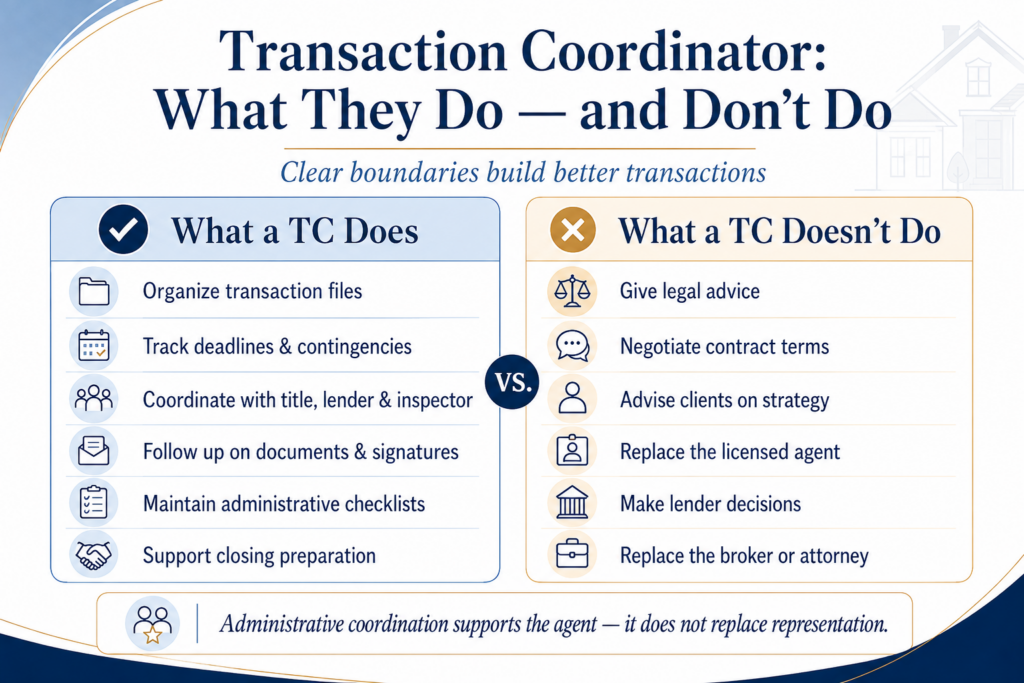
One of the most important questions is not only “What does a transaction coordinator do?” but also what shouldn’t the TC take over?
| Responsibility | Transaction Coordinator | Real Estate Agent |
|---|
| Organize transaction documents | Typically yes | Oversees transaction |
| Track contract dates | Yes | Remains responsible |
| Send deadline reminders | Yes | Makes client-facing decisions |
| Coordinate administrative updates | Yes | Yes |
| Follow up with title/lender | Typically yes | As needed |
| Maintain transaction checklist | Yes | Oversees |
| Upload brokerage documents | Often | As required |
| Give real estate advice | No, unless legally authorized within the person’s licensed role | Yes |
| Recommend contract strategy | No | Yes |
| Negotiate price or contract terms | No | Yes |
| Advise client whether to waive a contingency | No | Yes |
| Represent buyer or seller | No, merely by serving as TC | Yes, when acting as licensed representative |
| Make decisions for the client | No | Agent advises; client decides |
Key principle: Delegating transaction administration does not mean delegating representation.
That distinction protects the agent, the client, and the TC relationship.
What Does a Transaction Coordinator Do for Buyers and Sellers?
Transaction coordination also changes depending on which side of the transaction the agent represents.
Buyer-Side Transaction Coordination
A buyer-side TC may assist with administrative tracking related to:
- Executed purchase agreement
- Earnest money documentation
- Inspection milestones
- Financing updates
- Appraisal status
- Title information
- Required disclosures
- Association documents when applicable
- Final walkthrough coordination
- Closing details
- Final file documentation
The agent remains responsible for guiding the buyer through decisions involving negotiations, inspections, financing issues, contingencies, and contract changes.
Seller-Side Transaction Coordination
A seller-side TC may assist with:
- Executed purchase agreement processing
- Disclosure documentation
- Buyer and cooperating-agent information
- Title coordination
- Inspection-related administrative follow-up
- Appraisal access coordination
- Seller closing information
- Required signatures and addenda
- Brokerage documentation
- Closing preparation
The underlying purpose remains the same on either side:
Build a reliable operational system around the transaction so fewer details depend solely on the agent’s memory or inbox.
What a Transaction Coordinator Does NOT Replace
A good TC gives an agent leverage.
However, leverage works best when everyone understands what remains with the agent.
A transaction coordinator is not a substitute for:
The Agent’s Judgment
The TC should not decide how an agent should respond to a negotiation, inspection issue, financing problem, or contractual dispute.
Client Representation
Clients still need their real estate professional to explain options, discuss strategy, provide permitted real estate advice, and advocate for their interests.
The Broker
Brokerage supervision and broker-level compliance responsibilities remain where the law and brokerage policies place them.
The Lender
The TC can request updates. The lender determines lending requirements and financing decisions.
The Title or Closing Professional
A TC coordinates with closing professionals but does not become the closing company simply by managing the transaction file.
Legal or Tax Professionals
Transaction coordinators should not provide legal or tax advice outside the scope of their qualifications.
ProfileTM Insight
The biggest misconception about transaction coordination is that the value comes from “doing paperwork.” Paperwork is only one piece. The real value comes from creating an operational system around every pending transaction: someone knows what has been completed, what is coming next, what is missing, and who needs to act. That structure is what makes a busy pipeline manageable.
What Does a Transaction Coordinator Do vs. the Real Estate Agent?
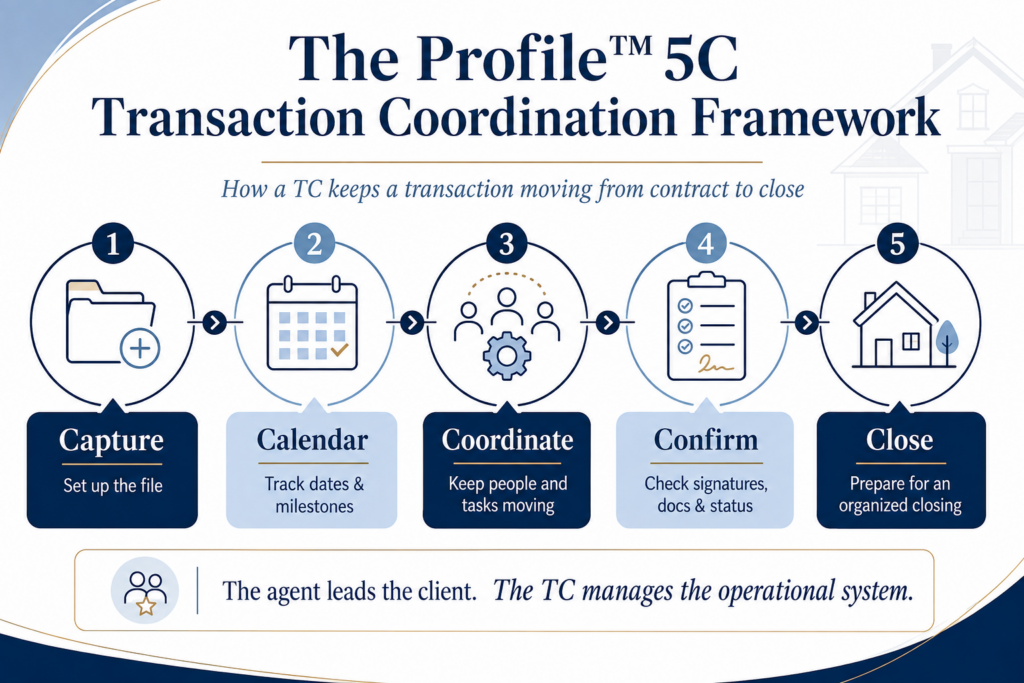
Agents evaluating a transaction coordination service can use this checklist to understand whether the service provides true contract-to-close support.
Real Estate Transaction Coordinator Setup Responsibilities
- Executed contract received
- Parties and contact information identified
- Transaction file created
- Documents organized
- Initial document review completed
Transaction Coordinator Deadline and Timeline Management
- Contract dates identified
- Important milestones entered into tracking system
- Deadline reminders established
- Changes to relevant dates documented when applicable
Document Management
- Required documents tracked
- Missing signatures or pages identified
- Addenda organized
- Brokerage documentation maintained
- File prepared for required review
Communication
- Title contact established
- Lender contact established
- Cooperating agent information confirmed
- Appropriate milestone updates sent
- Outstanding administrative items followed up on
Closing Preparation
- Closing information confirmed
- Final transaction details communicated
- Outstanding documentation checked
- Brokerage file organized
- Post-closing documents handled according to workflow
The exact checklist will vary by transaction, state, brokerage, and service provider.
Why Understanding What a Transaction Coordinator Does Matters for Growth
The purpose of transaction coordination is not to suggest that agents are incapable of managing their own files.
Most experienced agents can.
The more useful question is:
Should managing every administrative step of every transaction continue to be the best use of the agent’s time?
An agent might personally track a deadline, upload a disclosure, email title, follow up with the lender, locate a missing signature, update a client, and organize the brokerage file.
None of those tasks may take very long individually.
The problem is the accumulation.
Five minutes here, twelve minutes there, another interruption, another email, another document search—and the agent’s day becomes fragmented.
That fragmentation becomes even more significant as transaction volume grows.
Professional transaction coordination creates a defined back-office system so the agent can stay focused on the work that requires the agent.
That includes:
- Lead generation
- Listing appointments
- Buyer consultations
- Showings
- Negotiations
- Client strategy
- Database relationships
- Business development
For high-producing agents, transaction coordination is less about getting “help” and more about designing a business that does not require the agent to personally touch every administrative task.
When Does a Transaction Coordinator Become Most Valuable?
A TC can provide value at many production levels, but several warning signs suggest an agent has outgrown a completely do-it-yourself transaction process.
You may be ready for transaction coordination when:
- You are regularly working on paperwork at night
- You frequently stop prospecting to deal with pending transactions
- You keep deadlines in multiple places
- You repeatedly search email for transaction information
- Clients contact you because they are unsure what happens next
- Brokerage files require last-minute cleanup
- You are managing several pending transactions simultaneously
- Your production is growing faster than your administrative system
- You want to increase volume without immediately hiring a full-time employee
For ProfileTM’s core clients—high-volume solo agents and growing teams—the question is often not whether they are capable of handling transaction management themselves.
It is whether they can continue doing it themselves without creating a ceiling on growth.
What Does a Great Transaction Coordinator Do Differently?
Not every transaction coordinator provides the same level of service.
The strongest coordinators combine real estate process knowledge with operational discipline.
Look for these qualities:
Proactive Communication
A strong TC does not only respond when something goes wrong. They regularly identify what comes next.
Extreme Attention to Detail
Names, dates, signatures, addenda, deadlines, and documents matter.
Consistent Systems
Every transaction should follow a repeatable process rather than depending on memory.
Clear Boundaries
Professional coordinators know which matters belong with the TC, agent, broker, lender, title company, or attorney.
Responsiveness
Real estate transactions move quickly. Slow administrative communication creates unnecessary uncertainty.
Adaptability
Every brokerage has different systems, and every agent has a preferred way of communicating with clients.
Accountability
When something is outstanding, the coordinator tracks it until responsibility has been clearly handed to the appropriate person.
Frequently Asked Questions About Transaction Coordinators
What does a transaction coordinator do in real estate?
A transaction coordinator manages the administrative side of a real estate transaction. Typical responsibilities include organizing documents, tracking dates, coordinating communication, following up with title and lenders, maintaining transaction checklists, supporting brokerage file requirements, and preparing the transaction administratively for closing.
When does a transaction coordinator start working on a file?
For contract-to-close services, a TC typically becomes involved once the purchase agreement has been fully executed. The coordinator then establishes the transaction file, identifies important dates and parties, organizes documentation, and begins the contract-to-close workflow. Some companies also offer listing coordination or offer-writing services before a property reaches the pending stage.
Can a transaction coordinator talk to clients?
It depends on the coordinator’s service model, licensing status, brokerage policies, state law, and the type of communication involved. Administrative updates can be part of TC services, but real estate advice, representation, and activities requiring licensure must remain within the appropriate licensed role. Minnesota agents should follow Chapter 82 requirements and their broker’s policies.
Is a transaction coordinator responsible if a deadline is missed?
A TC can provide systems, tracking, reminders, and administrative follow-up, but hiring a coordinator does not automatically transfer the agent’s or broker’s contractual, professional, or legal responsibilities. Agents should understand the coordinator’s service agreement, brokerage policies, and applicable state requirements.
The Bottom Line: What Does a Transaction Coordinator Actually Do?
So, what does a transaction coordinator do?
A professional transaction coordinator builds and manages the administrative system that surrounds a real estate transaction.
They organize the file.
They track the timeline.
They coordinate the moving pieces.
They follow up.
They help maintain complete documentation.
They keep everyone informed.
And they help prepare the transaction for an organized closing.
But the best way to describe the role may be even simpler:
A great transaction coordinator makes sure the operational side of the deal keeps moving while the real estate agent stays focused on the people and decisions that require the agent’s expertise.
For an agent managing one transaction, that support can reduce administrative friction.
For an agent managing five, ten, or more active clients and transactions at a time, it can become part of the infrastructure required to grow.
Minnesota Real Estate Agents: Let ProfileTM Manage the Details
Your clients hired you for your expertise, negotiation skills, market knowledge, and guidance—not because you are good at chasing documents at 9:30 at night.
ProfileTM provides professional transaction coordination services for real estate agents in Minnesota and other supported markets.
Our team handles the contract-to-close administrative workflow, including transaction setup, deadline tracking, document management, title and lender coordination, compliance support, and proactive milestone communication.
You stay focused on clients, relationships, listings, negotiations, and your next closing.
We manage the details behind the transaction.
Learn more about ProfileTM Transaction Coordination Services
Minnesota agents: your next level of production should not require another level of administrative chaos.
If your pending transactions are taking time away from listings, buyers, prospecting, or your personal life, ProfileTM can become the contract-to-close support system behind your business.
Our Minnesota-based transaction coordination team manages paperwork, timelines, communication, and file organization so you can stay focused on the activities that actually require you.
Ready to stop being your own transaction coordinator?
Visit:
https://profiletm.com/transaction-coordination-services/